


In digital communication, latency refers to the delay between sending and receiving data: from
video streaming to High Frequency Trading in the world of finance, latency determines
responsiveness, efficiency and often, competitive advantage. And while latency is a universal
property of streaming networks, its significance varies widely across markets and applications.
In real-time video for example, a latency of sub-200 milliseconds is good enough to ensure
natural conversation. In consumer-facing web services, sub-100 millisecond performance
ensures users don’t feel like the system is lagging. However, when it comes to building
electronic marketplaces, for example, much lower latencies are required with small differences
in microseconds and even nanoseconds determining billions of dollars in outcomes.
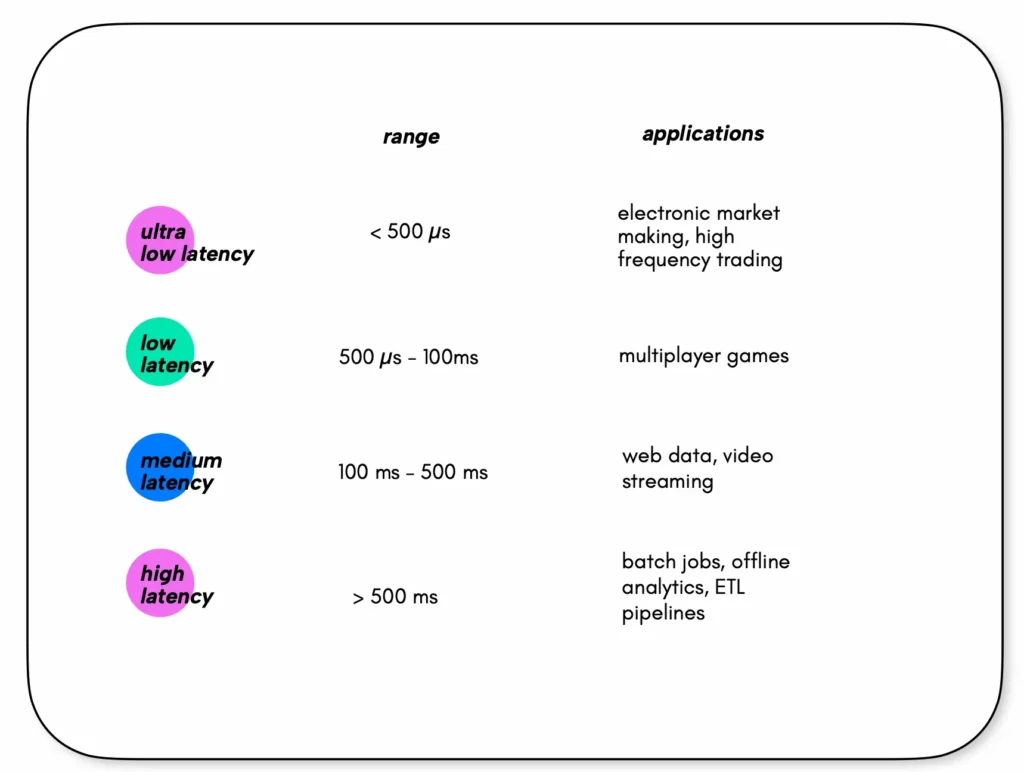
There is no universally agreed benchmark for measuring streaming data latency, but the
following table represents a broad overview of acceptable latencies in various
environments.
Medium latency – 500ms – 100ms
For large-scale web applications latency is important, but it often measured in milliseconds. For example, applications like Zoom or Microsoft Teams demand c. 100 ms one-way latency to support fluid, conversational exchanges. Once delays exceed 200 ms, participants notice lags that disrupt turn-taking. In another example, internal testing at Amazon revealed that every 100 milliseconds of latency cost them 1% in sales.
Low latency – 100 ms – 500 µs
For online multiplayer games, fairness hinges on latency – or “ping” – between players.
Competitive gaming requires <50 ms latency, with professional standards often at <20 ms.
While sub-millisecond improvements don’t matter to human perception, small differences
between players can decide outcomes in competition play.
Ultra-low latency < 500 µs
At the extreme end of the scale are ultra-low latency applications where latencies are measured in microseconds and nanoseconds. Applications like electronic market places require ultra-low performance to keep order execution fast. In high frequency trading applications single-digit microseconds or even nanoseconds can provide a vital advantage, and innovations such as microwave transmission or FPGA-based hardware deployed to find an edge. The reason is simple: if one firm can act 50 µs faster than another, it captures profit opportunities first. In this context, latency is not about user experience but about competitive advantage. Systems built for true high-frequency trading (HFT), typically implemented in C++ or other native languages, frequently operate in the single-digit microsecond range (e.g., ~1-10 µs tick-to-trade latency). At the extreme low-latency edge, hardware-based solutions using FPGAs (and often custom network stacks) can push into the sub-microsecond regime (hundreds of nanoseconds to ~1 µs). These FPGA-based deployments are largely the domain of specialty HFT firms focused on being first to act on market events.
Wingfoil benchmarks
Wingfoil is the ultra-low latency data streaming framework. Other widely available data streaming frameworks can’t function at ultra-low latency.
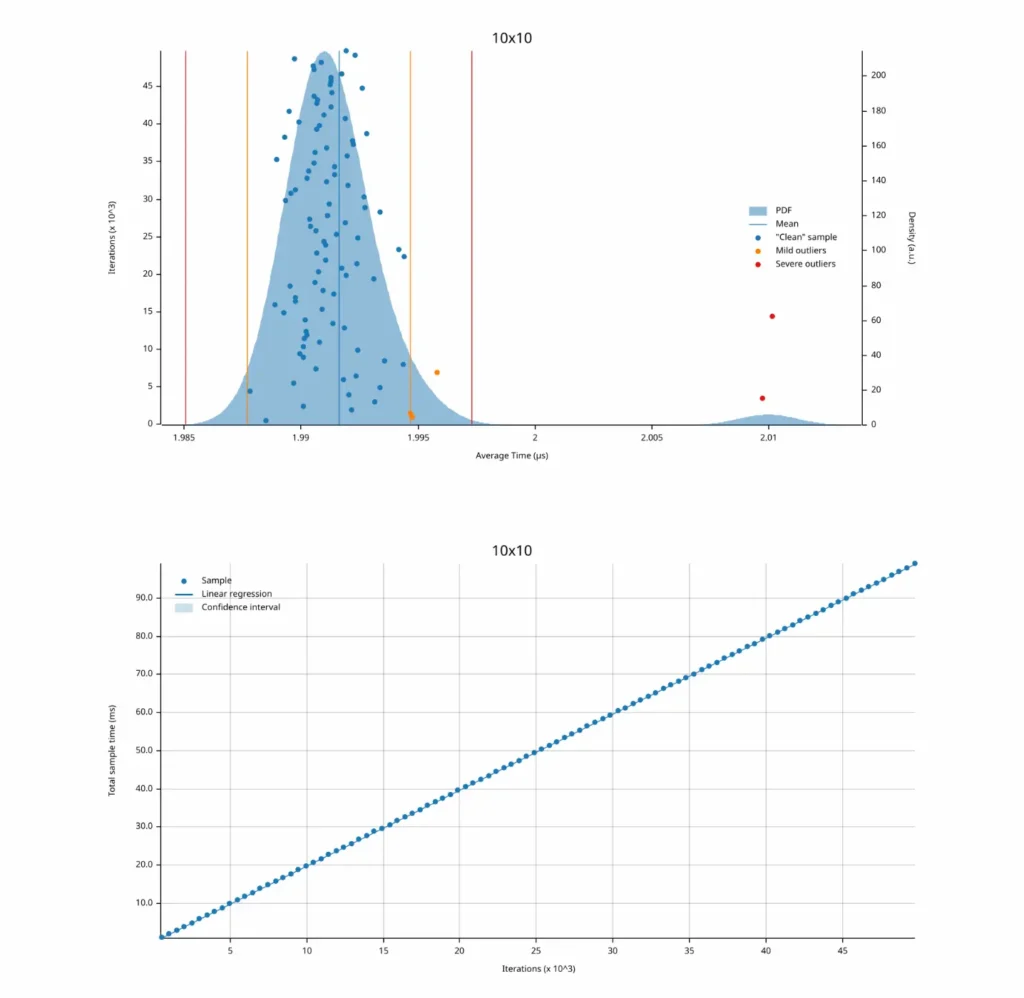
Here is some sample output for Wingfoil from the 10×10 benchmark.
In this benchmark we measure graph overhead by wiring up a trivial graph, 10 nodes deep and 10 nodes wide, with all nodes ticking on each engine cycle. Running on 3.80 GHz CPU, we observe a latency around 2µs per engine cycle, equivalent to 20ns per node cycle. For a smaller graph of 10 nodes, this would give a graph overhead around 200ns per engine cycle.

Of course, benchmarks measure peak theoretical performance using predictable, synthetic workloads in ideal environments and real-world usage is much more complex. But if you want to check Wingfoil’s performance for yourself in a production environment, then head on over to Crates and Github, download and deploy the Wingfoil framework and start testing it for yourself.